We have a brand new updated website! Click here to check it out!

UPDATE: US Attorney General ends policy that allowed legalized marijuana

WASHINGTON (AP) — The Trump administration threw the burgeoning movement to legalize marijuana into uncertainty Thursday as it lifted an Obama-era policy that kept federal authorities from cracking down on the pot trade in states where the drug is legal. Attorney General Jeff Sessions will now leave it up to federal prosecutors to decide what to do when state rules collide with federal drug law.

Sessions’ action, just three days after a legalization law went into effect in California, threatened the future of the young industry, created confusion in states where the drug is legal and outraged both marijuana advocates and some members of Congress, including Sessions’ fellow Republicans. Many conservatives are wary of what they see as federal intrusion in areas they believe must be left to the states.

Republican Sen. Cory Gardner, who represents Colorado, one of eight states that have legalized marijuana for recreational use, said the change contradicts a pledge Sessions made to him before being confirmed as attorney general. Gardner promised to push legislation to protect marijuana sales, saying he was prepared “to take all steps necessary” to fight the change, including holding up the confirmation of Justice Department nominees. Another Republican senator, Lisa Murkowski of Alaska, called the announcement “disruptive” and “regrettable.”

Colorado’s U.S. attorney, Bob Troyer, said his office won’t change its approach to prosecution, despite Sessions’ guidance. Prosecutors there have always focused on marijuana crimes that “create the greatest safety threats” and will continue to be guided by that, Troyer said.

The largely hands-off approach to marijuana enforcement set forth by Barack Obama’s Justice Department allowed the pot business to flourish into a sophisticated, multimillion-dollar industry that helps fund some state government programs. What happens now is in doubt.

“In deciding which marijuana activities to prosecute under these laws with the Department’s finite resources, prosecutors should follow the well-established principles that govern all federal prosecutions,” considering the seriousness of a crime and its impact on the community, Sessions told prosecutors in a one-page memo.

While Sessions, a longtime marijuana foe, has been carrying out a Justice Department agenda that follows Trump’s top priorities on such issues as immigration and opioids, this change reflects his own concerns. He railed against marijuana as an Alabama senator and has assailed it as comparable to heroin.

Trump, as a candidate, said pot should be left up to the states, but his personal views on marijuana remain largely unknown.

It is not clear how the change might affect states where marijuana is legal for medical purposes. A congressional amendment blocks the Justice Department from interfering with medical marijuana programs in states where it is allowed. Justice officials said they would follow the law, but would not preclude the possibility of medical-marijuana related prosecutions.

Officials wouldn’t say whether federal prosecutors would target marijuana shops and legal growers, nor would they speculate on whether pot prosecutions would increase.

They denied the timing was connected to the opening of California sales, which are projected to bring in $1 billion annually in tax revenue within several years. And, the officials said, Thursday’s action might not be the only step toward greater marijuana enforcement. The department has the authority to sue states on the grounds that state laws regulating pot are unconstitutional, pre-empted by federal law.

Asked about the change, White House spokeswoman Sarah Sanders said only that Trump’s top priority is enforcing federal law “and that is regardless of what the topic is, whether it’s marijuana or whether it’s immigration.”

The Obama administration in 2013 announced it would not stand in the way of states that legalize marijuana, so long as officials acted to keep it from migrating to places where it remained outlawed and keep it out of the hands of criminal gangs and children. That memo, written by then-Deputy Attorney General James M. Cole, had cleared up some of the uncertainty about how the federal government would respond as states began allowing sales for recreational and medical purposes.

But the Sessions Justice Department believed the Cole memo created a “safe harbor” for marijuana by allowing states to flout federal law, Justice Department officials said. Sessions, in his memo, called the Obama guidance “unnecessary.”

He and some law enforcement officials in states such as Colorado blame legalization for a number of problems, including drug traffickers who have taken advantage to illegally grow and ship the drug across state lines, where it can sell for much more.

Marijuana advocates argue those concerns are overblown and contend legalizing the drug reduces crime by eliminating the need for a black market. They quickly condemned Sessions’ move as a return to outdated drug-war policies that unduly affected minorities.

Sessions “wants to maintain a system that has led to tremendous injustice … and that has wasted federal resources on a huge scale,” said Maria McFarland Sanchez-Moreno, executive director of the Drug Policy Alliance. “If Sessions thinks that makes sense in terms of prosecutorial priorities, he is in a very bizarre ideological state, or a deeply problematic one.”

But the decision was a win for marijuana opponents who had been urging Sessions to take action.

“There is no more safe haven with regard to the federal government and marijuana, but it’s also the beginning of the story and not the end,” said Kevin Sabet, president and CEO of Smart Approaches to Marijuana, who was among several anti-marijuana advocates who met with Sessions last month. “This is a victory. It’s going to dry up a lot of the institutional investment that has gone toward marijuana in the last five years.”

Yet confusion remains.

Jane Stinson, part-owner of the retail marijuana shop Enlighten Alaska in Anchorage, called Thursday’s action confusing and worried that it could harm her business. The change, she said, “can have so many ripple effects we just don’t know.”

The change reflects yet another way in which Sessions, who served as a federal prosecutor at the height of the drug war in Mobile, Alabama, has reversed more lenient Obama-era criminal justice policies. While his Democratic predecessor Eric Holder told federal prosecutors to avoid seeking long mandatory minimum sentences when charging certain lower-level drug offenders, for example, Sessions issued an order demanding the opposite, telling them to pursue the most serious charges possible against most suspects.

A task force Sessions convened to study pot policy made no recommendations for upending the legal industry but instead encouraged Justice officials to keep reviewing the Obama administration’s more hands-off approach, something Sessions promised to do.

————-

WASHINGTON (AP) — Attorney General Jeff Sessions is going after legalized marijuana. Sessions is rescinding a policy that had let legalized marijuana flourish without federal intervention across the country.

That’s according to two people with direct knowledge of the decision. They were not allowed to publicly discuss it before an announcement expected Thursday and spoke on condition of anonymity.

The move will leave it to U.S. attorneys where pot is legal to decide whether to aggressively enforce federal marijuana law. The move likely will add to confusion about whether it’s OK to grow, buy or use marijuana in states where it’s legal, since long-standing federal law prohibits it.

The decision comes days after California began selling recreational marijuana.

Sessions compares marijuana to heroin and blames it for spikes in violence.

Oklahoma man held on $100K bond after Kansas traffic stop

Croslin -photo Barton Co.

BARTON COUNTY — Law enforcement authorities are investigating a suspect on drug distribution charges.

Just before 4a.m.Wednesday, Barton County Sheriff’s Office deputies stopped a vehicle for tag and other traffic violations in the 900 block of East US 56 Highway near the City of Ellinwood, according to Sheriff Brian Bellendir.

Deputies observed what appeared to be drug paraphernalia in the vehicle. A K-9 officer was called from Stafford County leading to the discovery of methamphetamine, marijuana and prescription opioids. The officers also discovered packaging material and scales.

Deputies arrested Michael “Spike” Croslin, 47 of Hobart, Oklahoma. Croslin was transported to the Barton County jail where he was booked on charges of possession of methamphetamine with intent to distribute, possession of opioids, and possession of marijuana with intent to distribute. Croslin was also charged with various traffic violations.

Croslin is currently being held in the Barton County Jail in lieu of $100,000 bond.

Fiddle once owned by music legend donated at KC Goodwill

Photo Courtesy Goodwill

KANSAS CITY, Mo. (AP) — A fiddle that Goodwill believes was once owned by country music legend Roy Acuff is expected to generate thousands of dollars for the charitable organization in the Kansas City area.

The fiddle was donated anonymously to Goodwill of Western Missouri and Eastern Kansas and is being sold in an online auction at shopgoodwill.com. As of Thursday morning the high bid was $7,780. The auction is open until 11 p.m. Central time Saturday.

Acuff died in 1992 at age 89. He was the first living inductee into the Country Music Hall of Fame, best known for hits such as “Wabash Cannonball and “Tennessee Waltz.”

The fiddle was made by Evart Acuff, Roy Acuff’s uncle, in August 1945 in Maryville, Tennessee. It isn’t clear why it was donated to a Kansas City Goodwill store.

“We recognized right away that it was something special and we now have it up for auction,” Raines said. “We have no information on the owner. They just donated it and moved on.”

The fiddle, made of apple wood apparently from a tree on a family farm, is now in the possession of Gary Raines, who runs Goodwill’s e-commerce program in Kansas City. He said he was confident the fiddle was Acuff’s, even though the certificate of authenticity and other paperwork are copies. The report didn’t explain how Raines reached that conclusion.

Acuff, a native of Maynardville, Tennessee, first became famous as the singer and fiddler for the Crazy Tennesseans, later called the Smoky Mountain Boys. Their hits also included “Wreck on the Highway,” ”Pins and Needles” and “Night Train to Memphis.”

Acuff performed regularly at the Grand Ole Opry and starred in the 1940 film “Grand Ole Opry.” In 1942, he and Fred Rose formed Acuff-Rose Music, which became a powerful country music publishing firm.

Kansas couple jailed after police find them hiding in apartment

Moreno-photo Saline Co.

SALINE COUNTY — Law enforcement authorities are investigating two suspects on drug and child endangerment allegations.

Just before 1 a.m. Wednesday, police received a call from 31-year-old Meaghan Moreno, according to Salina Police Captain Paul Forrester. She told police that someone was hurt inside her apartment in the 700 block of Fairdale Street in Salina.

When officers arrived, Moreno and her husband, 31-year-old Robert Moreno, did not let officers enter the apartment. When police did finally gain access, they found Meaghan, Robert and a four-year-old girl hiding.

Meaghan appeared to be under the influence of methamphetamine, according to Forrester. A search of the residence uncovered 8-grams of meth and drug paraphernalia.

Police placed the child into protective custody and arrested the parents.

They were booked on requested charges for possession of methamphetamine, possession of drug paraphernalia and child endangerment.

K-9 with Kansas Sheriff’s office dies after hit by car

Biz-photo courtesy Code 2 K9 Services LLC

DICKINSON COUNTY —  The K-9 with the Dickinson County Sheriff’s Department died in an accident on Friday, according to Sheriff Gareth Hoffman.

Early afternoon December 29, 2-year-old Biz, a Belgian Malinois, escaped from his Kennel and was hit by a car in the 1200 Block of Northwest 3rd Street in Abilene, according to Hoffman.  A broken latch on the kennel allowed the dog to get out.

The Dickinson County Sheriff’s Department purchased Biz in 2016 in Nebraska.  “We used no tax dollars to purchase the dog,” said Hoffman. “We fully intend to maintain the K-9 program here and will use no tax dollars.”  The dog was insured.

Authorities are not actively looking for who hit the dog. No one has reported it. “They are in no trouble,” said Hoffman. “It was an unfortunate accident.”

1 of 2 victims of Kansas grain elevator accident identified

Tice-photo courtesy YouCaring.com

WICHITA, Kan. (AP) — One of the two men killed in a Kansas grain elevator has been identified.

Marcus Tice left behind a wife and two stepdaughters. Relatives on Wednesday confirmed his identity. The second victim has not been identified.

The men died Tuesday at the Gavilon Grain elevator in south Wichita. The bodies were recovered about three hours after the men became buried under 20 to 25 feet of grain. It isn’t clear how they got into the bin and what caused them to become trapped.

Friends and relatives of Tice have established an online fundraiser to assist his wife.

First responders on the scene of Tuesday gran bin incident south of Wichita-photo courtesy KWCH

The Occupational Safety and Health Administration is investigating.

Defense in domestic terror case wants jurors from rural western Kansas

Gavin Wright, Curtis Allen and Patrick Stein are charged with domestic terrorism

WICHITA, Kan. (AP) — Attorneys for three men accused of plotting to bomb a mosque and apartment complex housing Somali refugees urged a federal judge on Wednesday to include prospective jurors from rural western Kansas because they are more likely to have voted for President Donald Trump.

But the government countered that granting the request would as a matter of policy “wreak havoc,” saying the defense is seeking to pick a jury pool based on ideology while “opening a dangerous door” to similar requests in other cases.

U.S. District Judge Eric Melgren took the matter under consideration after a hearing in U.S. District Court in Kansas, saying he would try to rule quickly. The trial begins March 19 in Wichita.

Gavin Wright, Patrick Stein and Curtis Allen are charged with conspiracy to use a weapon of mass destruction and conspiracy against civil rights for allegedly planning to detonate truck bombs in the meatpacking town of Garden City the day after the November 2016 election. Wright also faces a charge of lying to the FBI.

The three men, who were indicted in October 2016, have pleaded not guilty.

Prosecutors have argued the men formed a splinter group of the militia Kansas Security Force that came to be known as “the Crusaders.” Wright is quoted in a wiretap transcript as saying he hoped the attack on the Somalis would “wake people up” and inspire others to take similar action against Muslims.

The defense contends the case will require jurors to weigh whether the alleged conduct constitutes a crime or whether it is constitutionally protected speech and assembly and the right to bear arms.

Defense attorneys had argued that court plans to only summon citizens in the more urban counties closest to the federal courthouse in Wichita is a discriminatory practice that excludes rural and conservative jurors. But the judge during the hearing noted several counties surrounding the federal courthouse in Wichita already used to draw potential jurors are rural counties.

Kansas voted overwhelmingly for Trump in the 2016 election, and Melgren mused during the hearing that he does not see a material difference between picking a jury pool from a group that voted two-thirds for Trump as compared to a group that voted three-fourths for Trump. During the campaign Trump called for a crackdown on immigration and a ban on Muslims entering the country.

But attorney Kari Schmidt, who represents Wright in the case, told the judge there is a difference in the belief systems between people in rural southwest Kansas where the crimes allegedly occurred and people in the other rural counties near Wichita that the judge cited in making his comparison.

“I don’t think I can say it’s legally recognizable, but factually recognizable,” she said.

The government cited legal cases finding that groups of prospective jurors defined by geographical location are not “distinctive” groups for purposes of a constitutional attack on a prospective jury pool. By contrast, women and racial groups are considered distinctive groups for such purposes. Prosecutors contended the defense request would set a “dangerous precedent.”

“At its core, it is seeking to stack the deck,” Justice Department attorney Risa Berkower said.

Trump disbands voter fraud commission that included Kan. Sec. of State

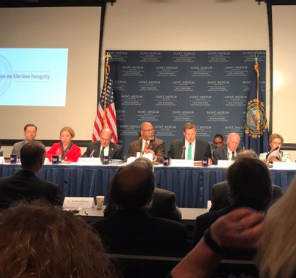
Kansas Sec. of State Kobach at meeting of President Donald Trump’s commission on election fraud

WASHINGTON (AP) — President Donald Trump is disbanding his controversial voter fraud commission amid infighting, lawsuits and state officials’ refusal to cooperate.

Trump convened the commission to investigate the 2016 presidential election, after alleging repeatedly and without evidence that voting fraud cost him the popular vote. Trump won the Electoral College.

The White House blamed the decision to end the panel on more than a dozen states that have refused to comply with the commission’s demand for reams of personal voter data, including names, partial Social Security numbers, voting histories and party affiliations.

“Rather than engage in endless legal battles at taxpayer expense, today President Donald J. Trump signed an executive order to dissolve the Commission, and he has asked the Department of Homeland Security to review its initial findings and determine next courses of action,” White House spokeswoman Sarah Huckabee Sanders said in a statement Wednesday.

Critics saw the commission as part of a conservative campaign to make it harder for poor people and minority voters to access the ballot box, and to justify Trump’s claims of voter fraud.

Trump has repeatedly alleged, without evidence, that 3 million to 5 million people voted illegally in the 2016 election, delivering the popular vote to his Democratic rival, Hillary Clinton. Clinton received more than 2.8 million more votes than Trump nationwide.

While there have been isolated cases of voter fraud in the U.S., past studies have found it to be exceptionally rare.

Critics also viewed the commission as part of an attempt to distract from the ongoing investigations into Russian election meddling and potential collusion between Moscow and Trump campaign aides. The intelligence community concluded that the Russian government mounted a campaign to help Trump win, hacking email accounts and spreading false stories.

Kansas Secretary of State Kris Kobach, a conservative Republican and the commission’s vice chairman, characterized the decision to dissolve the bipartisan group as a “tactical change” and argued DHS can pursue an investigation of election fraud more quickly and efficiently.

“The Democrats, both on and off the commission, made very clear that they were not interested in determining the scope and extent of voter fraud and, indeed, they were trying to stop the commission in its tracks,” Kobach said. “The Democrats lost their opportunity, lost their seat at the table, by stonewalling.”

Kobach, a vocal supporter of tough voter ID laws, alleged Democrats wanted no investigation. “Their motto is, ‘Nothing to see here,'” he said.

One of the members of the commission, Democratic Maine Secretary of State Matthew Dunlap, sued the commission in federal court, alleging it had violated federal law by refusing to provide him documents available to other members, among other charges.

Dunlap on Wednesday said Kobach and his allies “were the ones that were stonewalling,” saying they had “very definite ideas of what they wanted this commission to come up with.”

Three Democratic senators — Michael Bennet of Colorado, Cory Booker of New Jersey and Amy Klobuchar of Minnesota — had also asked the U.S. Government Accountability Office to investigate the commission, which it agreed to do in October.

Kobach said he intends to work closely with DHS and the White House and expects the bulk of the DHS investigation to be done by midsummer.

More than a dozen states, as well as the District of Columbia, had rebuffed the commission’s request for voter data, citing privacy concerns and a fear that complying would legitimize the idea that voter fraud is widespread.

While there have been isolated cases of people voting illegally, and many voter rolls contain outdated data, there is no evidence voter fraud is a widespread problem in the United States or has affected election results.

A study by a Loyola Law School professor found that out of 1 billion votes cast in all American elections between 2000 and 2014, there were only 31 known cases of impersonation fraud.

During the commission’s first meeting, Trump had questioned the motives of states that refused to comply with the commission’s request, suggesting they had something to hide.

Voter advocacy groups and Democrats applauded Wednesday’s decision.

“It is no surprise that a commission founded on a lie of widespread voter fraud proved to be a fraud itself,” said California Secretary of State Alex Padilla, a Democrat, who had refused to comply with the commission’s request for voter data. “No taxpayer dollars should have been wasted on Mr. Trump’s voter suppression crusade.”

Dale Ho, director of the American Civil Liberties Union Voting Rights Project, accused the commission of engaging in “a wild-goose chase for voter fraud, demonizing the very American voters whom we should all be helping to participate — with the not-so-secret goal of making voting harder with unnecessary barriers.

“President Trump has tried and failed to spread his own fake news about voter fraud,” Ho said.

Police: Missing Kansas mother, 1-year-old found safe

Photo courtesy Wichita PD

UPDATE:

Police reported Samantha Riggs and Matthew Riggs have been located safe in Riley County. They released no additional details.

——–

WICHITA — Law enforcement authorities are asking the public for help to locate a missing woman and her son.

Just after 10am Sunday, Samantha Riggs, 23, Wichita became upset and walked away from her family home with her one-year-old son Mathew Riggs, according to officer Charley Davidson.

Matthew was wearing only a pair of white pajamas with multicolored dinosaurs. The mother was wearing black tights with a grey tee shirt and grey hoody. A citizen gave them a ride to the QT at Pawnee and Meridian.

The citizen left and returned with a child’s black Old Navy coat with a yellow stripe down each sleeve and gave it to the mother. She mentioned to the citizen that they were waiting for a ride to Manhattan, Kansas.

Riggs-photo Wichita PD

According to the family the mother is mentally challenged and is not capable of taking care of her child without supervision. If you see them or have any information please call 911.  The picture is the pajamas the child was last seen wearing.

Kansas City man charged with stealing Jeep with boy inside

Alexander -photo Jackson Co.

KANSAS CITY, Mo. (AP) – Court records say a Kansas City man stole a Jeep with a toddler inside before driving up to an officer about an hour later, admitting to the theft and asking for directions.

Prosecutors announced Tuesday that 37-year-old Kenneth Alexander is charged with child kidnapping and motor vehicle theft. It wasn’t known if he had an attorney. Bond is set at $75,000.

The Jeep was stolen after a mother left her four children in it Sunday while she went inside a store. Surveillance shows a man force three children from the vehicle before speeding away with a 20-month-old inside.

Police say Alexander was apparently under the influence of drugs when he was arrested in nearby Belton. Alexander told police the boy, who wasn’t harmed, was his stepson and named “Johnny Cash.”

Copyright Eagle Radio | FCC Public Files | EEO Public File