RICE COUNTY — Law enforcement authorities have confirmed the identity of a body found in rural Rice County on December 22.
The body of 42-year-old Dennis Galliart of Reno County was found in a wooded area near Sterling, according to Rice County Sheriff Bryant Evans.
Authorities still have a lot of unanswered questions and have not determined the cause of death.
“We are still waiting toxicology results,” said Evans.
OMAHA, Neb. (AP) — A business conditions index for nine Midwest and Plains states rose over the past month, pointing to continuing improvement in regional economic conditions, an economist said in a report released Tuesday.
The Mid-America Business Conditions Index climbed to 59.0 from 57.2 in November, the report said. The October figure was 58.8.
In Kansas, the overall index climbed to 62.0 last month, a regional high, and up from November’s 58.0. Index components were new orders at 72.4, production or sales at 63.9, delivery lead time at 57.0, employment at 60.5 and inventories at 56.3.
“Although the inflation gauge is elevated, I would characterize the region as having a ‘goldilocks’ economy,” said Creighton University economist Ernie Goss, who oversees the survey. “That is not so hot as to push the Federal Reserve to raise interest rates at a stepped-up pace, but not so cool as to slow employment gains.”
The regional wholesale inflation gauge cooled to a still strong 71.3 from November’s 71.4, reflecting the regional inflationary pressures.
“Even though both our regional wholesale inflation index and the U.S. inflation gauge are elevated, I expect the Federal Reserve to forgo a short-term interest rate hike at the next meeting of their rate-setting committee on Feb. 1.” Goss said. But he also said he expected a quarter-point increase at the March 15 meeting.
The survey results are compiled into a collection of indexes ranging from zero to 100. Survey organizers say any score above 50 suggests growth in that factor. A score below that suggests decline. The survey covers Arkansas, Iowa, Kansas, Minnesota, Missouri, Nebraska, North Dakota, Oklahoma and South Dakota.
Looking ahead six months, the December business confidence index rose to 73.2 last month from 71.9 in November.
“Healthy profit growth, still low interest rates and the recently passed tax reform package pushed business confidence to its highest level since January 2011,” Goss said.
The regional jobs picture showed improvement as well, as the December employment index climbed to 57.7, compared with 53.6 in November.
“Over the past 12 months, the regional manufacturing sector has added approximately 29,000 jobs, a 2.1 percent expansion,” Goss said. “This annual regional manufacturing growth rate significantly exceeds the 1.5 percent growth for U.S. manufacturing.”
SHAWNEE COUNTY — Law enforcement authorities are investigating a suspect on weapons charges.
Just after 4p.m. on New Year’s Eve, a subject armed with a handgun was reported in the 1000 Block SW 33rd terr. in Topeka, according to Lt. Colleen Stuart.
The subject was reported to be at the residence of the subject’s former spouse. The family members were able to leave the home safely and call police.
As officers arrived the subject called into the dispatch center and was transferred to an on-scene officer.
After speaking for several minutes, the subject came outside and was taken into custody without incident. The firearm was secured and confirmed as stolen. The subject was determined to have a felony history.
Police transported David Almanza, 36, to the Department of Corrections for theft and criminal possession of a firearm.
LAWRENCE, Kan. (AP) — A man has been arrested in the shooting death of a woman at a Lawrence apartment.
The Lawrence Journal-World reports that the man had been sought since the death Wednesday night of 30-year-old Lei Ala Turner.
The suspect identified as Willie Kenith Franklin, 27, Lawrence, was booked into jail early Monday morning on suspicion of involuntary manslaughter and being a felon in possession of a firearm.
Last night, Willie Kenith Franklin, 27, of Lawrence, was arrested for the shooting death of Lei Ala Turner on Wednesday. Franklin has been booked into jail on charges of Involuntary Manslaughter and Felon in possession of a Firearm
TOPEKA— Law enforcement authorities are investigating a stabbing and have a suspect in custody.
Just after 11p.m Sunday, police responded to the 2100 Block of SW High in Topeka on a report of several male subjects armed with knives in a parking lot beating another man, according to Lt. Colleen Stuart.
All involved subjects had left prior to officer’s arrival. Officers were then called to a local hospital for a subject with injuries consistent with having been stabbed.
The victim advised officers he was struck several times with a knife after having an altercation with a known subject over a game. The victim’s injuries were considered non-life threatening. Officers responded back to the 2100 Block SW High to locate the suspect in this incident.
Deques Brown 35, was taken into custody without incident and transported to the Department of Correction for aggravated battery and a warrant from another county. Brown has previous convictions for drugs, aggravated battery of a law enforcement officer and flee, attempted flee-elude law enforcement, according to the Kansas Department of Corrections.
DICKINSON COUNTY — Law enforcement authorities are investigating a suspect on drug charges.
On Friday, the Dickinson County Sheriff’s Department reported the county drug enforcement unit, police and parole officers executed a search warrant at a home in the 300 Block of Opal Road lot 20, Red Rock Trailer Court, Abilene on December 20.
Deputies arrested 22-year-old Austin Michael Johnson of Abilene on suspicion of felony count of Possession of Methamphetamine, Possession of Marijuana, Possession of Drug Paraphernalia, on misdemeanor counts of Possession of Drug Paraphernalia, Endangering a Child and a Parole violation.
During the search of the residence, law enforcement officers seized methamphetamine and marijuana along with drug paraphernalia. Prior to conducting the search warrant there was a child present in the residence. Johnson has two previous drug convictions, according to the Kansas Department of Corrections.
The case is ongoing and further arrests are possible, according to Hoffman.
MANHATTAN — Activist and philanthropist Joyce Banda, the first female to serve as president of the African nation of Malawi, will present a Landon Lecture at 10:30 a.m. Monday, Jan. 29, 2018, at Kansas State University. Banda’s lecture will be in Forum Hall at the K-State Student Union and is open to the public.
“It a privilege to welcome her excellency, Joyce Banda, to Kansas State University as a Landon Lecturer,” said Jackie Hartman, chair of the Landon Lecture Series and the university’s chief of staff and director of community relations. “As the second female to lead an African nation, President Banda helped turn her country’s economy around and has been a longtime champion of women’s rights.”
As president of Malawi from 2012-2014, Banda was credited with turning around the nation’s ailing economy. Under the economic reforms she instituted, Malawi’s rate of economic growth rose from 1.8 percent in 2012 to more than 6.2 percent in 2014. In that same time span, Malawi’s operational industrial capacity rose from 35 percent to 85 percent.
Banda also repealed a number of laws which had weakened democratic institutions, infringed on civil liberties and restricted freedom of the press. The health of women and children was a priority in Banda’s presidency. She established the Presidential Initiative on Maternal Health and Safe Motherhood, which helped drop the maternal mortality rate in Malawi.
Before becoming president of Malawi, Banda served as the nation’s vice president, foreign minister, minister of gender and child welfare, and as a member of its Parliament. As minister of gender and child welfare, she championed enactment of the Prevention of Domestic Violence Bill in 2006, which provided the legal framework to support the prevention and elimination of all forms of violence against women and girls.
Since leaving office, Banda serves on the boards of Nutrition International Canada and the Tana High Level Forum of Peace and Security in Africa. She is a member of the Council of Women World Leaders and a distinguished fellow with the Woodrow Wilson International Center for Scholars and the Center for Global Development.
The founder of the Joyce Banda Foundation International in 1997, Banda continues her work with the foundation today to transform villages in Malawi by supporting women’s economic empowerment, education, maternal health and HIV/AIDS programs, leadership training and human rights. She also serves as a panelist and motivational speaker at international conferences and forums.
Banda’s work has drawn many honors. She was named one of the world’s most powerful black women by Forbes magazine in 2013 and 2014; one of the most influential people in the world by Time and Forbes; and one of the most inspirational women in politics by CNN.
Her degrees include a bachelor’s in gender studies from Atlantic International University and a master’s in leadership from the Royal Rhodes University of Canada.
Intersection where the carjacking occurred-photo courtesy Fox-4 Kansas Cty
KANSAS CITY, Mo. (AP) – Police say a toddler who was inside a vehicle when it was carjacked in Kansas City has been found safe in a nearby suburb.
The Kansas City Star reports that the carjacking occurred around 11 a.m. Sunday when a man forced himself into the sport utility vehicle and then forced the driver and some children out, except for the 18-month-old boy.
Surveillance video from a nearby business shows the man and another person get in and speed away. The woman gave chase on foot and then in a taxi as the SUV headed south.
Belton police reported finding the SUV and the child about an hour later. An unidentified suspect was taken into custody.
The names of the woman and child haven’t been released.
HARPER COUNTY — The new year got off to a shaky start in Kansas. A small earthquake shook south-central Kansas. The quake just after 2a.m. measured a magnitude 2.6 and was centered approximately 22 miles south of Anthony, according to the U.S. Geological Survey.
It is the first quake in Kansas since a pair of quakes including a 3.1 magnitude temblor were reported in Harper County on December 15.
There are no reports of damage or injury from Monday’s quake.
In the summer of 2005, the Legislature butted heads with the Kansas Supreme Court over a ruling that ordered an influx of money to public education.
The result? Kansas came closer than ever to a constitutional crisis.
With Kansas facing a similar Supreme Court deadline this spring, state lawmakers are talking about ways to challenge or restrict the court’s authority on the topic of K-12 funding. A special committee formed to address the latest court ruling will meet Monday and Tuesday at the Statehouse.
Key participants in the 2005 special session sat down with the Kansas News Service in recent weeks to share their memories of the 12 days in the House — and 11 in the Senate — when lawmakers debated defying the justices but ultimately backed down.
In the process, they missed a critical court deadline that raised the stakes of the session — and had people who doubted a school shutdown could ever happen rethinking their assessment.
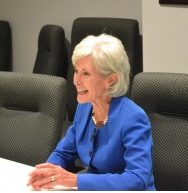
Kathleen Sebelius was governor of Kansas in 2005, when the Legislature and the Kansas Supreme Court sparred over school finance as part of the Montoy v. Kansas case.
‘Time is running out’
Kathleen Sebelius, governor at that time, recalled calling the special session that brought lawmakers back to Topeka in late June 2005.
That spring, the Legislature had attempted to resolve a school finance lawsuit — Montoy v. Kansas — by adding $142 million to the state’s education spending. Sebelius suspected that wasn’t enough. Though she didn’t veto the bill, she declined to sign it.
“I said that over and over during the session,” she said. “So we sent it quickly to the court without my signature.”
Sebelius believed the bill fell short of two requirements the state had to meet: putting enough money into schools to help student outcomes and distributing the money in a way that was fair to resource-poor school districts.
On June 3, 2005, the court agreed, ordering the Legislature to double that $142 million figure by the start of the new fiscal year on July 1 — an important date for school district budgets. The justices settled on that amount based on a school finance study the Legislature had commissioned four years earlier.
“Time is running out for the school districts to prepare their budgets,” the justices wrote in explaining the July 1 deadline. “The Legislature has known for some time that increased funding of the financing formula would be necessary.”
Sebelius wanted the Legislature to comply, and many moderate Republicans agreed.
“We thought we were putting an adequate amount of money in, but the court thought otherwise,” recalled former Senate president Steve Morris, of Hugoton. “So I thought, well we’ll just have to do what we have to do.”
Sebelius set a June 22 start date for the special session and Morris called a few of the Senate’s committees back early to craft legislation that would meet the court’s demands. When the full Senate returned, it passed the bill on its first day.
That’s not to say senators had no reservations about the situation. After passing the legislation, some Senate Republicans set to work pursuing possible constitutional amendments that would tie the court’s hands on school finance in the future.
Court out of bounds?
The House, meanwhile, was at a standstill. Complying with the court ruling was anathema to conservative leaders there who saw it as caving to a branch of government overstepping its authority.
“We were pretty shocked that this court would not only weigh into that issue,” said then-representative Mike O’Neal, referring to school finance, “but literally order the Legislature to appropriate a certain amount of funds.”
The Hutchinson Republican was the longtime chairman of the House judiciary committee and argued that separation of powers doctrine — and in particular provisions in the Kansas Constitution and legal precedent — meant the court was out of bounds.
Democrats and some moderate Republicans disagreed.
“We have equal branches of government, and we need to remember that,” Morris said.
The lack of a resolution frustrated members of the Senate who wanted the House to wrap up its work, get the money to schools and allow everyone to go home.
“At one point I put out a news release where I called it ‘Mays malaise,’” Senate Minority Leader Anthony Hensley said, referring to then-Speaker of the House Doug Mays. “They were unable to do anything.”
Mays, a Topeka Republican who left the Legislature a year later, didn’t respond to an interview request for this article.
Constitutional questions
Talk of potentially defying the court by ignoring its ruling, or asking Kansas voters to amend the state constitution, continued. The Kansas Constitution had — and still has today — a provision requiring the Legislature to suitably fund public schools, and potential ideas in 2005 included adding a line to it barring the court from weighing in on that matter.
In a legislative hearing, Washburn University law professor Bill Rich testified against the idea.
“That would mark a really radical change in the history of the relationship between the judicial and legislative branch,” Rich said.
It effectively would have carved out part of the constitution as unenforceable by the courts, Rich argued, and that could have broader implications. If lawmakers wanted to prevent judicial scrutiny of their compliance with a constitutional duty, Rich said, they should ask voters to remove that duty from the Kansas Constitution.
In this case, that would have meant deleting the clause requiring Kansas to suitably fund public schools. But asking the public to do that may not have been politically palatable.
“I think the Legislature knew that that was not going to pass,” Rich said.
As the impasse continued, lawmakers missed the court’s July 1 deadline, raising the possibility of school closure.
Political and government leaders knew school closure was a risk because a lower court ruling had made that clear. Absent a constitutional school finance system, the judicial branch was prepared to strike down the current one. In doing so, the court would block its implementation, which meant stopping the flow of money to schools.
The missed deadline increased pressure on everyone. School administrators like Randy Weseman, then superintendent of the Lawrence district, weren’t sure how long they would have the authority to keep paying the bills in the new fiscal year.
“When you’re talking about not providing education in August for 11,000 kids, 2,000 employees,” Weseman said, “it’s a huge undertaking to talk about just stopping that train.”
For Weseman, the matter was further complicated by the fact that Lawrence, a growing district, was in the middle of building new schools. He and other administrators watching the stalemate in Topeka began preparing to ask the Kansas Supreme Court to allow schools to continue paying certain critical expenses.
An ‘intense’ July 1 meeting
But the schools never closed. Two things happened in quick succession that appear to have pushed the legislative process forward. One was a closed-door nighttime meeting July 1 in Sebelius’ office, with key players like Morris, Hensley and Mays all present.
Mays reportedly left abruptly, dodging the questions of reporters waiting outside the room.
Hensley described the meeting as “very intense.” Mays knew, he said, that Democrats and moderate Republicans had been discussing a bill to comply with the court.
The other event, the next morning, was an order from the state Supreme Court, which wasn’t pleased with the Legislature missing its deadline. The justices gave state lawyers six days to prepare for appearing in court and presenting any last-minute arguments against blocking the flow of money to schools.
In the days that followed, the House and Senate negotiated.
“We basically had to pay the ransom and make sure the schools were going to open,” said O’Neal, who was one of the six negotiators.
They reached a resolution, and both chambers signed off on it two days before state lawyers were due back in court. That was a relief for moderate Republican leaders like Morris.
“It felt like we had taken a load off,” he said. “We had done what we needed to do.”
‘Quite a bit of reform’
O’Neal said conservative Republicans didn’t leave the negotiating table empty-handed. The final law approved by both chambers on July 6 included a raft of policies O’Neal and others pushed for.
Those included a policy goal for schools to spend at least 65 percent of their state aid on instruction, new procedures for filing school finance lawsuits against the state and provisions barring the courts from enforcing any rulings by cutting off money to schools.
“We felt like we got quite a bit of reform in exchange for writing a bigger check,” O’Neal said.
All attempts in 2005 to pursue a constitutional amendment, which would have required a two-thirds majority in each chamber before proceeding to a public vote, failed.
As for the statutory ban on closing schools, which lawmakers did pass, it’s not clear that the courts consider it binding absent a constitutional amendment. In more recent school finance rulings, cutting off money to schools has remained an option on the table despite the 2005 law.
Celia Llopis-Jepsen is a reporter for the Kansas News Service. You can reach her on Twitter @Celia_LJ.