JACKSON COUNTY — Law enforcement authorities are investigating a suspect for theft and drug charges following a high-speed chase.
Just after 9:30a.m. Saturday, a Jackson County Sheriff’s Deputy stopped a 2002 Honda Civic with Missouri plates near 150th and Q. Road in Jackson County, according to a media release.
The vehicle’s tag was reported to have been stolen from Blue Springs, Missouri and the vehicle was reported stolen out of Lee Summit, Missouri.
The deputy ordered the driver to shut off the vehicle, the driver failed to follow the order and left the scene prompting a pursuit.
Local agencies assisted with the pursuit that led across parts of the Prairie Band Potawatomi Nation and Jackson County and into the City of Holton.
While near the south side of Holton the suspect vehicle entered the parking entrance of the Banner Creek Animal Clinic and then drove through a yard of a residence.
Law enforcement officers on the scene of Saturday’s chase-photo Jackson Co. Sheriff
The vehicle then again attempted to elude law enforcement by driving through a KDOT fence gaining access once again to US Highway 75 and northbound through the City of Holton.
The vehicle then went north of Holton and east and ended up driving into the Prairie Lake city park. The vehicle went to the southeast side of the dam leaving the roadway and crashed into a small creek where the vehicle came to a stop. Law enforcement officers took the driver identified as Robert Joseph Calisti, 28, Olathe, into custody at that location at approximately 10:13a.m., according to the sheriff’s department.
Calisti is being held in the Jackson County Jail on felony possession of stolen property, felony flee and eluding and a number of traffic crimes and drug charges. Further charges on Calisti may occur including Stolen property (car & tag), Felony flee and elude, criminal damage to property, Possession of methamphetamine, Possession of Drug paraphernalia, Possession of marijuana, Reckless driving and leaving the scene of an accident. Two others in the vehicle have not been charged.
ALLEN COUNTY — Three people died in an accident just after 5:30p.m. Sunday in Allen County.
The Kansas Highway Patrol reported a 2006 Toyota Corolla driven by Ashley Nicole Walters, 20, Warrensburg, MO., was northbound on U.S. 169 four miles south of Iola. A deer came out of the east ditch, striking the Toyota.
A southbound 2012 Dodge Grand Caravan driven by Sherry Laraine Bingham, 33, Chanute, then struck the deer and traveled into the southbound ditch. Vehicle one came to a stop on the northbound shoulder.
Bingham and passengers Ciara Joan Edwards, 32, Chanute, and Samantha Rnee McMillan, 37, Walnut, were pronounced dead at the scene and transported to Frontier Forensics. Walters was not injured. All four were properly restrained at the time of the accident, according to the KHP.
Approximate location of the investigation- google map
MITCHELL COUNTY— Law enforcement authorities are investigating a suspicious death in north-central Kansas.
Just after 1a.m. Saturday, officers and deputies responded to the 400 Block of East Court Street in Beloit for a report of an unresponsive person with a head injury, according to a media release.
Offices found a man dead from his injuries. The Kansas Bureau of Investigation, Mitchell County Sheriff’s Office and Beloit Police Department are investigating the circumstances and awaiting autopsy results. Authorities did not release the victim’s name or additional details.
At this time, there is no reason to believe there is a public safety concern.
TOPEKA, Kan. (AP) — A Kansas legislative task force on child welfare is meeting this week after several legislators raised concerns about how state policies are affecting families.
The Child Welfare Task Force is scheduled to meet Tuesday at the Statehouse. Its agenda includes a look at the court system’s role in protecting abused and neglected children.
The task force’s meeting comes after a joint legislative budget committee reviewed data from showing that 44,000 people have become ineligible for cash assistance under policies that include work requirements for able-bodied adults.
Meanwhile, the number of children in foster care has grown in recent years, and critics of Republican Gov. Sam Brownback are linking the two trends. The Department for Children and Families contends the social services policies help make welfare recipients self-sufficient.
SPRINGFIELD, Mo. (AP) – A southwest Missouri jury’s inability to decide whether a man should be put to death for kidnapping and killing a 10-year-old girl sets up a rare situation where a judge will make that decision.
Circuit Judge Thomas Mountjoy is scheduled to announce Jan. 11 whether Craig Wood will get the death penalty or life in prison. Wood was convicted of killing Hailey Owen in Springfield in February 2014 but the Greene County jury couldn’t reach a unanimous decision on his sentence.
The Springfield News-Leader reports Missouri and Indiana are the only states where a judge can impose a death sentence. But in 2016, the U.S. Supreme Court ruled that only a jury, not a judge, can make that decision.
SEDGWICK COUNTY — Law enforcement authorities are investigating an armed robbery and searching for the suspect.
Just before 2p.m. Saturday officers responded to an armed robbery call at Payless Shoe Source in the 2100 block of north Amidon in Wichita, according to officer Charley Davidson in a media release.
A 19year-old employee told officers an unknown suspect entered the store, and indicated he had a gun. Money was given to the suspect who fled the store in a dark green 1990’s model 4-door car.
There were no injuries reported. The suspect is described as a 40-year-old black male, 6-foot-3, 250lbs, muscular build, wearing a brown coat, blue jeans, black stocking cap, brown shoes, sunglasses, and purple ear buds in his ears.
If anyone has any information on this case please call Wichita Police.
DENVER (AP) — The draining of a massive aquifer that underlies portions of eight states is drying up steams, causing fish to disappear and threatening the livelihood of farmers who rely on it for their crops.
The Denver Post reports that it analyzed federal data and found the Ogallala aquifer shrank twice as fast over the past six years compared with the previous 60.
Also known as the High Plains Aquifer, the Ogallala underlies 175,000 square miles including portions of Colorado, Wyoming Kansas, Nebraska, New Mexico, Oklahoma, South Dakota and Texas.
The U.S. Geological Survey said in a June report that the aquifer lost 10.7 million acre-feet of storage between 2013 and 2015.
Water levels in the Ogallala have been dropping for decades as irrigators pump water faster than rainfall can recharge it.
MEADE COUNTY— A child died in an accident just after 1a.m. Sunday in Meade County.
The Kansas Highway Patrol reported a 2001 Chevy Suburban was westbound on Meade county road V one mile west of Kansas 23.
The driver lost control around a curve. The vehicle went into the south ditch and rolled.
Occupants of the vehicle Felipe James Tomas, 2; Isabel Solis-Gomex, 23 and Vicente Tomas-Tino, 34, all of Friona, TX, were transported to the hospital in Meade.
The 2-year-old died. The toddler was in a car seat and not buckled up, according to the KHP.
The other 2 occupants were also not wearing seat belts. The KHP did not have information on who drove the Suburban.
GARDEN CITY – A former Finney County man pleaded guilty to felony theft and deceptive commercial practice, according to Kansas Attorney General Derek Schmidt.
David Rosales, 41, now of Leawood, pleaded guilty on Tuesday in Finney County District Court to one felony count of theft and two counts of misdemeanor deceptive commercial practice.
The case stemmed from an investigation by the Garden City Police Department and the attorney general’s office, which discovered that Rosales contracted to do plumbing and construction work under the auspices of being licensed but in fact he was not. He then accepted payment from three consumers and did little or no work. The crimes occurred between August and October 2012.
District Judge Franklin Pierce took the plea and scheduled sentencing for December 13 at 2 p.m. in Finney County District Court.
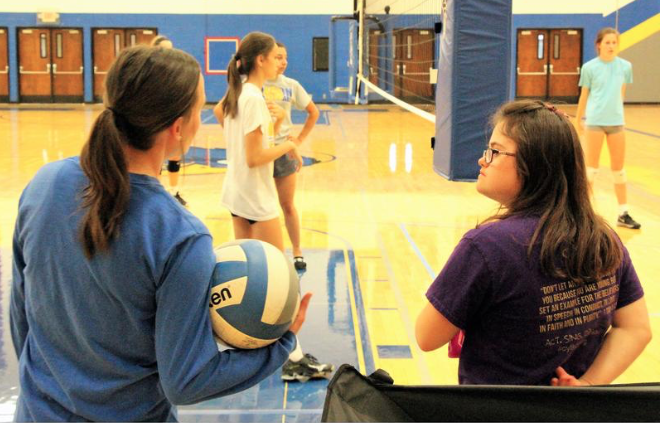
A Kansas education policy has raised concerns among advocacy groups who say it may exclude thousands of students in academic achievement gaps. That includes students with disabilities, like Rachel Mast, right, a senior at Olathe South High School. CELIA LLOPIS-JEPSEN / KANSAS NEWS SERVICE
ByCELIA LLOPIS-JEPSEN
Kansas’ approach to implementing a federal law on equity in education would fail to promote achievement for thousands of students the law was meant to protect, civil rights advocates say.
But state education officials counter that there are good reasons for their strategy designed to ensure that Kansas schools are evaluated fairly.
At issue is Kansas’ blueprint for complying with federal requirements meant to close academic achievement gaps among students in traditionally disadvantaged and underserved demographic groups.
Those include racial and ethnic minorities and students from low-income families, who have disabilities or are learning English as a second language.
National advocacy groups — ranging from the NAACP and American Civil Liberties Union to the National Down Syndrome Congress and League of United Latin American Citizens — have urged states to set a high bar for implementing the federal requirements.
“There’s still a high percentage of kids not getting diplomas that we know can perform better,” said Ricki Sabia, a senior policy adviser for the National Down Syndrome Congress. “Sometimes the only way to see what works, what doesn’t work is to have accountability.”
Kansas is one of eight states taking a more limited approach to the federal law than the rest of the country by making fewer schools fully accountable to it.
The National Down Syndrome Congress believes this will have “a devastating impact” for monitoring how well schools serve children with disabilities.
Kansas education officials disagree.
Education Commissioner Randy Watson said the state’s K-12 accreditation system and support systems for schools extend far beyond its efforts to meet federal requirements — with goals for boosting the academic success of every child.
“We try to take a much broader approach,” Watson said, “and say, ‘How do we serve every kid in Kansas?”
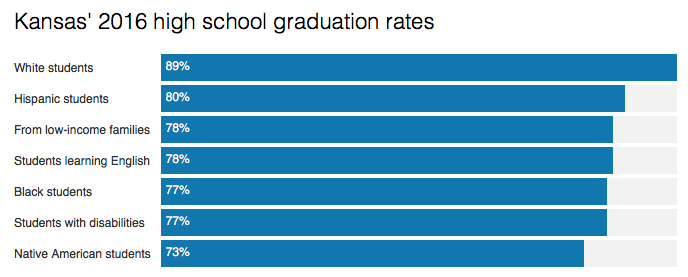
The Achievement Gap
Click to expand
Nationally and in Kansas, academic achievement gaps persist, leaving millions of children without the high school diplomas and postsecondary education that open doors to self-reliance and economic stability in adulthood.
White students are more likely to be proficient in math and reading — as measured by standardized tests — and graduate from high school than their black, Hispanic and Native American peers. The gaps are evident, too, for students who don’t speak English at home, have disabilities or come from low-income families.
“These are the categories around which educational opportunity has historically been denied,” said Liz King, director of education policy for the Leadership Conference on Civil and Human Rights in Washington, D.C. “We need to know whether or not schools are removing barriers.”
King’s organization is one of more than 20 advocacy groups that sent letters to Watson and other state education chiefs urging them to apply the federal law rigorously and maximize accountability.
“The value for children in this,” King said, “is action to improve their quality of education.”
What groups like the Leadership Conference are unhappy about is Kansas’ decision regarding a key statistical threshold central to implementing the 2015 Every Student Succeeds Act, or ESSA.
The act requires states to monitor progress of underserved student groups and identify schools struggling to close achievement gaps. States must target resources and interventions to help those schools, and they receive federal dollars to do so.
Each state was allowed to hammer out the logistics on its own. Kansas submitted its proposal to the U.S. Department of Education in September, with a goal of eliminating achievement gaps statewide by 2030. It is awaiting federal approval.
The statistical threshold in question is known to education wonks as the “N-size.” It’s the number of students in any given demographic category that a school must serve before being held accountable for the achievement of that group.
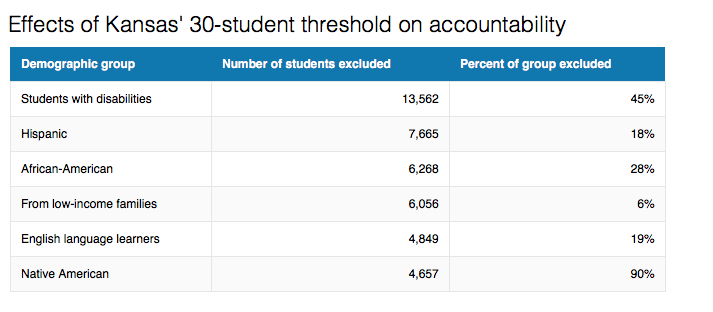
Kansas set the bar at 30. A Kansas public school with at least 30 black students will fall under the ESSA accountability system for that category. A school with 29 or fewer won’t. The same goes for each of the other student groups.
At that threshold, nearly 30 percent of black students will be excluded from the accountability monitoring. Ninety percent of Native Americans and nearly a fifth of Hispanic students and English language learners will be in the same boat.
But in sheer numbers, no group is affected more than students with disabilities. Nearly half of them will be excluded — more than 13,500 children and teens.
The statistical debate
Source: Kansas State Department of Education draft analysis -click to expand
This won’t be new for Kansas, because the state used the same threshold under ESSA’s predecessor, the 2001 No Child Left Behind law.
But under ESSA — a law that many educators view as less punitive than No Child Left Behind — states were asked to revisit their thresholds, and some lowered them so they could monitor the progress of more students.
That means Kansas is now at the high end of the spectrum — one of eight states opting for a threshold of 30. Most set the bar at 10 or 20 students. The Leadership Conference recommends 10.
Brad Neuenswander, Kansas deputy education commissioner, said the state’s goal is statistical validity. Thresholds that are too small run the risk of producing average graduation rates and math and reading test scores that don’t really reflect efforts.
“There’s more accuracy in the larger numbers,” Neuenswander said. “If you’re going to make a claim about whether or not a district is providing the services, we want it to be statistically accurate.
“When you get down really low, it’s very likely you’re going to identify a building based off a very easily identifiable family. Or a family moves in, and all of a sudden something happens because of that group. Not really anything the district did.”
Civil rights groups agree the threshold needs to be high enough to provide quality data and respect student privacy, but they argue 30 is excessive.
There’s no consensus among academics on where the sweet spot is — the number that would hold schools as fully accountable as possible without homing in on groups of students that are too small to measure soundly.
“There’s clearly no magic number for what the right N-size threshold should be,” said Dan Goldhaber, vice president of the American Institutes for Research and an expert in education data. “It’s a trade-off.”
A lower threshold helps ensure schools where children are struggling don’t get overlooked, he said, but a higher threshold increases confidence that the data from each school truly reflects meaningful differences in student outcomes among schools.
Jerry Meier, a retired principal who steered a large Topeka middle school through the rise of standardized testing and federal accountability, sees advantages and disadvantages on both sides.
“I don’t believe there is an easy answer,” he said. “I think it’s hard on the state.”
He’s skeptical of states that picked numbers as small as 10, which he says could be particularly problematic for measuring the academic progress of children receiving special education services because disabilities vary greatly.
But he also finds it somewhat troubling that nearly half of students with disabilities are excluded under the Kansas ESSA plan.
“I truly understand the parents who say, ‘We need to make (the threshold) a smaller one, because I want my child to be counted in the accountability. That way I know the school is held under the gun, so to speak,’” he said.
Public input
Jawanda Mast is one of those parent advocates.
Her daughter, Olathe South High School senior Rachel Mast, is graduating in May and plans to attend college next year.
Rachel, who has Down syndrome, is manager of the school’s volleyball team and takes a full slate of core academic classes alongside her peers without disabilities — opportunities that her mother believes have helped prepare her for life after high school.
Mast said federal laws have, for decades, pushed schools to better serve children who face developmental, learning or behavioral challenges. ESSA, the latest iteration of federal education legislation that arose out of the civil rights movement of the mid-20th century, is no exception.
“Probably you’re going to have to have some oversight to get people to do the right thing,” she said. “I hate to say that, but I think that’s just the reality. And I think if you’re getting federal funding, I think you should be accountable to the federal government for what you’re doing.”
A Kansas News Service article earlier this fall included Mast’s concern that Kansas made little effort to communicate with the public about its ESSA plan and seek broad feedback before finalizing it.
In part, Mast wanted a public discussion of Kansas’ 30-student threshold, and access to information about how many more children would be included if Kansas chose a smaller number.
Federal law required states to engage parents, teachers and other groups in choosing that number. But Kansas, unlike some states, didn’t release information to the public about the threshold and the number of students it would exclude from the monitoring system.
Nor did education officials share the figures with the advisory council of about 40 educators and advocates that they convened for the purpose of providing input on Kansas’ ESSA plan.
“I don’t know how that’s possible without giving them data on the exclusion rates,” she said.
Neuenswander says Kansas’ engagement with stakeholders on accountability thresholds took place over several years, prior to ESSA.
“We had already had all those discussions over the last five — four to six — years,” he said. “We had those conversations with … our special education advisory council and across the field.”
And since then, he said, the education and advocacy groups that his department communicates with regularly through various advisory councils haven’t pushed for any changes.
“I’ve yet to have one person say, ‘I’d like to have a conversation about N-size,’” he said.
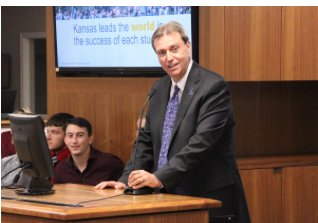
Education Commissioner Randy Watson and other Kansas officials say the state monitors and accredits schools through its own school quality checks, independent of the federal government. CREDIT FILE PHOTO / KANSAS NEWS SERVICE
Representatives for two key school administration groups in Kansas said they have not heard interest from their members in rethinking the state’s threshold from what it was under No Child Left Behind.
“Kansas administrators are very comfortable with that N-size,” said G.A. Buie, executive director of United School Administrators of Kansas, an umbrella group that includes associations of principals, special education administrators and other school leaders.
“It’s not really been something we’ve looked at or hear about,” said Mark Tallman, a lobbyist for the Kansas Association of School Boards.
Both said school leaders are busy monitoring student outcomes independently, regardless of the federal system.
“We’re looking at individual students,” Buie said. “We’re concerned with each individual student.”
And Watson and Neuenswander said there is plenty of incentive to make sure teachers and principals do their best for those students, even if their schools fall short of Kansas’ ESSA threshold.
The state monitors and accredits schools through its own school quality checks, independent of the federal government.
It also publishes academic outcomes and demographic breakdowns for many schools that don’t fully factor into Kansas’ federal accountability plan, as well as statewide aggregated data on outcomes by demographic group, so the public can still view that data.
“We have multiple accountability systems through the state system that goes way beyond any federal requirement,” Neuenswander said.
Celia Llopis-Jepsen is a reporter for the Kansas News Service. You can reach her on Twitter @Celia_LJ.